4) China: Rare Earth Elements. Lesson thirtysix

Although China extracts 98 percent of the world’s rare earth elements, like Neodymium, which in small amounts together with some Boratoms to keep everything in place are used to “dope” magnetic iron so that they become stronger (Neodymium magnets) and other elements that have recently been used in high-tech contexts, it’s difficult for them to use the ore as an economic weapon.

There are also much China is dependent on which comes from the surrounding world, like agricultural products and fuel oil, as well as copper and other metals. China alone stands for 2/5 of the worlds consumption of coal, aluminum, zinc and copper. Therefore, the Chinese are doing mining and oil business with countries that Europe and America consider too dubious to do business with, African countries with a horribly low level on human rights, that China benefits from. China is a relatively resonable trading partner for western countries. As of 2015, the only mining company of its kind in the United States – Molycorp – which used to capitalize rare earth elements, filed for bankruptcy due to unfavorable Chinese competition.

The problem is that REE (rare earth elements) is so difficult to extract from the soil. In May 2012, Japanese researchers discovered an estimated 6.8 million tonnes of rare earth metals near the island of Minami-Tori-Shima, which can supply Japan’s current industrial consumption for over 200 years.

Another recently developed source of rare earths is discarded electronics and other scrap that have components of REE. Progress in recycling of electronics has made the extraction of REE from junk possible and recycling stations have recovered hundreds of thousand tonnes of REE from electronic junk. In France, two factories have been built that will recycle 200 tonnes of REE per year from end-of-life fluorescent lamps, magnets and batteries.

China has no real market advantage despite their introducing of restrictive export quotas from 2010 and also their stopping of production, and despite their extraction of REE in China linked to the Chinese state. In March 2012, the United States, the EU and Japan confronted China in the WTO. China claimed that the export quotas were maintained for the sake of the environment. (Well, sometime would be the first.) Chinese export restrictions failed in 2012 since prices on REE fell in response to the opening of other production sites. [In January 2015, China lifted all export quotas of REE, but export licenses will still be required. It is unclear if they thought they were the only ones who had raw materials in sufficient quantities, but the Chinese had misjudged the power of the free market and for the moment being they have already used up their advantage.

In 2013, Rand Corporation published a report that stated that the US economy is “critically dependent” on 14 different raw materials produced in countries with weak regimes and that China has a market-controlling position on 11 of these raw materials. China has introduced production monitoring, export restraints, closing of mines and restructuring of production within China’s own borders. In the same year, the United States’ Energy Department announced that they had created a new institute with an annual budget of $ 120 million called the Critical Materials Institute. The aim is to avoid the consequences of scarcity of raw materials, which threaten to put obstacles in the way of transition to alternative energy forms. Five so-called rare earth metals (neodymium, europium, terbium, dysprosium and yttrium) are listed on the institute’s website as such critical raw materials. Two non REE raw materials are also included in this category. Calculations showed that there would be an imbalance of about thirty percent between supply and demand already in 2016. This primarily affects electricity production by wind and solar power. A major problem is that there is no acceptable alternative to oil for propulsion of vehicles and aircraft. There is no other substance with that much energy content per transported unit than oil products and which does not cost astronomical sums to produce with now known technology. Without transport, we would return to the stoneage. Every country needs to look out for its supply of crude oil to meet both civil society’s need for fuel in peacetime and sustain its military in the event of conflict. Source: KKrVA, Ingolf Kiesow

Source; KKrVA, Ingolf Kiesow

Homework:

Will REE become a big issue in the future you think? Short term or long term?

Roger M. Klang, defense political Spokesman for the Christian Values Party (Kristna Värdepartiet) in Sweden
1) China: Nine Dash Line. Lesson thirtythree

There is a slim possibility for the Americans, but still a possibility, to fuel conflicts on several fronts so that they would not have to face China alone. Here’s what the CIA’s former public site LIGNET expressed on July 17, 2013:

Why the Indian Ocean Could Be the Next Theater of War
While China has loudly trumpeted its new aircraft carrier and its developing “blue water” navy, India has quietly embarked on its own naval modernization program, with a new aircraft carrier on order from Russia and a new nuclear submarine now undergoing sea trials. Both China and India have their eyes on the Indian Ocean and on guarding the oil tankers that traverse it. The recent advances in the navies of both nations set up the potential for a clash there.

And here’s what the CIA expressed on LIGNET september 24, 2013:

China, Russia Compete for Influence Over Central Asia
China and Russia are engaged in an intense rivalry for hegemonic control over Central Asia, a rivalry that could jeopardize the close friendship that has developed between them over the past two decades. What will China’s unquenchable thirst for energy and Russia’s desire to revive the glory of its former empire mean for the future of the region?

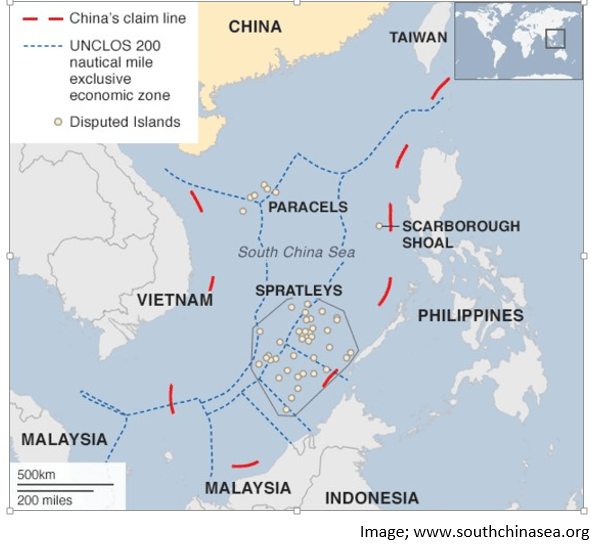
The United States has no desire that the Spratly Islands and the Paracel Islands in the South China Sea should explode in their face. Some of the Spratly Islands are controlled by Vietnam, others by the Philippines and some islands by Taiwan and some by China. The islands are hard to reach but the surroundings are believed to contain raw material resources. Due to the seemingly unresolvable disputes, there have been no serious explorations of deposits in the areas, so the estimation of commodity resources is largely extrapolated from mineral deposits in neighboring areas.

China has built a runway, 10 flight minutes in mach 1 (approximate speed for sound waves or 1,224 km/h) from the Philippine Islands, on one of the Spratly Islands called Mischief Island 200 nautical miles (370 km or 230 miles) from the Philippines. Conflicts (i.e., Chinese hijacking) regarding the ownership of the islands are undesirable. China claims virtually the whole of the South China Sea and commits violations of other countries’ legal rights to an economic zone under the UNCLOS Convention on the Law of the Sea. China calls their self-imposed demarcation lines for the nine-dash line.

On the largest island, known as Woody Island in the States, in the disputed Paracel archipelago south of China, it is believed that China has deployed surface-to-air missiles. In 2012, China established a military garrison as well as the city of Sansha on the island to administer the entire South China Sea. In 2015, China temporarily deployed fighter jets on Woody Island. Many countries claim ownership of several of the Paracel Islands in the archipelago, countries such as Taiwan, Vietnam, the Philippines, Malaysia and Brunei. Woody Island is located about 300 km (186 miles) southeast of the giant island of Hainan in southern China.

China wants to conduct bilateral negotiations, but many of China’s neighboring countries argue that China’s strength and size are giving the country an unfair advantage. ASEAN (Association of SouthEast Asean Nations) cannot even resolve the dispute. The US says they do not choose side in territorial disputes, but they have frequently sent military ships and flights near the disputed islands and they call it “Freedom of navigation” operations. In addition to these islands, there are dozens of rocky reefs, atolls and sandbanks, such as Scarborough shoal, mostly uninhabited. These data were current in July 2016.

Already President Obama declared in his State of the Union speech on February 12, 2013, that he (America) intended to pursue a Pacific Trade Agreement. With these few words in an one-hour speach he declared his intentions:

”To boost American exports. Support American jobs. And level the plane-field in the growing markets of Asia. We intend to complete negotiations on a transpacific partnership. And tonight I’m announcing that we will launch talks on a comprehensive transatlantic trade and investment partnership with the European Union. Because trade that is fair and free across the Atlantic, supports millions of good paying American jobs.”

What did he mean by “And level the plane-field in the growing markets of Asia”? It can only be interpreted in one way; an Obamish economic War declaration against China, by financially binding other east Asian countries to the United States, North Korea excluded. It should have been a piece of cake but Trump is less skillful and kid-gloved than most people.

Was it China that started the contentions? In 2012, China initiated formal talks in an economic union with a number of countries in east Asia and other places, including Australia, New Zealand, India, Japan and South Korea. The rounds of negotiations have succeeded each other and are known as RCEP (Regional Comprehensive Economic Partnership). The discussions have been going on for a long time, but God knows if they have reached an agreement as late as in November, 2018.

Homework:

What do You think Obama meant by “And level the plane-field in the growing markets of Asia”? Was it an unfriendly perhaps even hostile sentence?

And if it was hostile, was it a legitimate sentence? Please motivate your conclusions! Before answering the question, I want you to make an effort to justify your conclusions by searching for background material about the conflict so that you get training in fact finding and screening of information. Don’t come back to me with a foggy response, because you are biased and think this and that, only trying to prove what you already presuppose.

Fact searching means being able to walk a few miles in your opponent’s moccasins, i.e. you need to search for information and screen information not only on the home team’s site but on all possible sites. It is not the same as being unbiased because nobody really is, but If you always assume that your home team is right and that you therefore do not need to listen to the other side, you might as well skip doing this homework altogether. Be generally critical when seeking out information.

Every time you get suspicious, keep the thought in the back of your head until you can confirm it or until it has been falsified, even if it will take years of fact searching and contemplating. Your level of perseverance determines if you will become a good intelligence person or not.

Roger M. Klang, defense political Spokesman for the Christian Values Party (Kristna Värdepartiet) in Sweden

4) To be or NATO be. Lesson twentynine

Putin visited Finland in June-July 2016 in conjunction with Russia’s up to date biggest readiness control exercise, which was carried out on August 25-31, 2016. It was an informal visit, and according to Russia, they didn’t sign any agreements. Sauli Niinistö and Putin discussed “the relations between Finland and Russia and the situation in Europe”. Before that Putin and the Finnish president Sauli Niinistö met as recently as March 2016 in Moscow.

Nato held a summit in the first week of July 2016, where it was agreed to deploy four reinforced battalions in the Baltic countries and in Poland, which Russia naturally opposed.

At a previous meeting in Finland the Moderate (Moderaterna = alleged right wing political party in Sweden) Karin Enström, Vice Chairman of the Swedish Parliament’s Foreign Affairs Committee, criticized Niinistö for meeting with Putin. Niinistö replied that Sweden does not keep up with what is happening in the world and that, e.g. The United States has an active dialogue with Russia. But you have to understand that Finland is cornered by Russia and that it was no coincidence that Putin took a trip over the border in conjunction with the Russian mass mobilization. What were discussed there can determine Sweden’s fate.

The country that wants to annex the Baltics and is located in the east, gain a huge advantage, if they undisturbed under false pretences that no Natoland is going to be affected, first can seize the large Swedish island of Gotland in the middle of the Baltic Sea. If they seize Gotland they can create a total A2AD (Anti Access/Area Denial) over large parts of Scandinavia and the whole of the Baltic Sea with advanced long range air defense systems.

I think that Russia will try to find cracks in the Swedish-Finnish relations. They hope that one country will not apply for NATO membership without the other country also doing so, and that there will therefore be no membership for any of the countries. In one way, the True Finns (political right wing party in Finland) are dangerous which have worked to strip the Swedish-speaking part of the Finnish people of their civil rights. It may come back to haunt them. I believe that Finland is more dependent on hooking on a Swedish membership than Sweden is dependent on hooking on a Finnish membership. Finland, with NATO’s eyes, can probably be more easily sacrificed than Sweden. It can put Finland in a difficult situation if Sweden joins the NATO organization without a co-signing together with Finland. It’s what happened when Sweden joined the EU. The Finns haven’t forgotten.

In the above diagram you can see who the weakest link in the chain is. It’s Germany. For my part, although Sweden is not a member of NATO, I am prepared to help defend a NATO nation in the Nordic region, if it is small, like the Baltic States or Iceland. But promises of military aid without first showing that you are really prepared to follow up on it are not worth much. So I am ready, if I were an authorized statesman, to let our Visby-class corvettes and our submarines, from time to time patrol the waters of the Baltic States in peacetime. I have already made a Baltic ex officer assurances and thus I cannot back down.

I am also ready to support Finland in different ways. But it doesn’t matter what I say, or even what our defense minister Peter Hultqvist says, if we do not have a plan for how the help should be executed in peacetime and in wartime or if we don’t have the means to help in any decisive way. We are not alone in not having a plan. NATO lacks or lacked a functioning plan since the United States doesn’t have any land-based persevering deterrent like medium-range ballistic missile systems with versatile types of war heads, like the Russian Iskander-M, which is deployed in Kaliningrad. The United States has phased out most of its tactical nuclear arsenal and the one that is available is not land-based, it is air and sea based.

This is the fourth and last lesson concerning Sweden, Finland and NATO. I hope I haven’t left the Finns with a grudge towards this patriotic Swede. I am prepared to help the Finns with whatever help we can allow ourselves to give to them, even officers and fighting units in Swedish uniform. A hypothetic war in the twentytwenties will be much more qualitatively materiel focused than in the Russo-Finnish winterwar in 1939-1940, and I am afraid that we are not going to be willing to supply the advanced materiel the Finns are going to need without also controlling its contributive forms. That means that wherever there is advanced Swedish equipment, it is going to be operated by Swedish personnel under Swedish command. At least if I have anything to say about it.

But first we need a solid plan and binding agreements.

Homework:

Can Sweden and Finland prevent that Russia could find cracks in our Swedish-Finnish relations? If so, how?

Please motivate your answer!

Roger M. Klang, defense political Spokesman for the Christian Values Party (Kristna Värdepartiet) in Sweden

3) To be or NATO be. Lesson twentyeight

I don’t think that an attack against Sweden will be of a military nature, but the attack will come in the form of a prolonged cyber operation and/or through an economic conspiracy against us. The only thing that can discourage the Russians from committing a cyber attack on Sweden is if we have an ability to attack Russia with the same means.

Georgia’s president Mikhail Saakashvili believed that NATO would intervene if Russia attacked Georgia militarily. But Georgia is more isolated localized geographically because there are only two access roads by land from the Nato country Turkey. Plus, the airport at Georgia’s capital Tbilisi is isolated. In addition, Turkey has a long history of turncoat policy regardless of the consequences for northern NATO countries and others, and it is the Turks who controls the straits of the Dardanelles and the Bosphorus into the Black Sea. A NATO intervention was hardly possible.

Georgia 2008 was the famous “litmus test”. It will of course be more of a risk-taking for Russia to attack Sweden before we can join NATO than it was to attack the isolated Georgia. But players come in plenty. Professor Rolf Tamnes, Norwegian historian and professor at the Department of Defense Studies (Institutt for forsvarsstudier – IFS), emphasizes that Russia does not trust Swedish non-alignment, since the extensive cuts in the Swedish defense force is considered as an incentive to seek external help, for example from NATO and the United States.

Apparently, it is not clear abroad what Swedish “non-alignment” stands for. In my opinion, it stands for freedom to choose alliance partners according to our own preferences. We should make this clear to the world, even if the outside world then will reject us even more, because uncertainties benefit us even less. We are sitting in the fox trap regardless.

How may Russia evaluate their geo-economic field and balance it with the geomilitary field?

1) Russia prefer to look at it as if the outside world is dependent on what they have to offer in the form of Russian gas and oil, but I believe that they realize that Germany may make themselves independent from the geostrategic Gazprom and thus Russia. They must keep the Germans happy.
2) It is almost a required condition that Russia is able to simultaneously attack the entire Baltics and parts of Scandinavia not to mention Iceland, if they intend to be able to count on free passage through Öresund, Kattegat and Skagerack, and they must be able to keep their main trading countries, e.g. the Netherlands and France.
3) This in turn requires that the United States first, nearly lose its superpower status. We therefore have no interest whatsoever in the United States losing its superpower status.

But I think that Sweden as a state must grant access to our territory for US troops on Swedish soil if we are to join NATO. It is not enough to receive a Naval ship visit from time to time, which we could also do as a non-aligned country in peacetime. I am not particularly happy to let 5,000 American hungry hearts invade a Swedish small town or one of our Baltic Sea islands in peacetime. Maybe we can do as Norway and let the US stock up materiel in Swedish bunker rooms?

Homework:

The US may have bases in Sweden as a requirement for a Swedish membership. Above all, an air defense base on one of our Baltic Sea islands and access to our airbases and ports. Otherwise the US will never have the time window to intervene in Scandinavia and even less in the Baltic countries, before Russia has swallowed parts of us. If the United States cannot intervene in time on our latitudes and longitudes, then it makes no sense for us to join NATO and we will probably then be denied membership.

But there is also the possibility to accomodate American service members families and thus unburden some pressure on our communities and our society as a whole. Let them contribute to our society and at the same time make it possible for them to use public services such as hospitals and schools at the same low cost as for Swedes. The schools should even be free of charge. I have absolutely no problems with Americans as a people.

Do you agree or not agree? Please motivate your position.

Roger M. Klang, defense political Spokesman for the Christian Values Party (Kristna Värdepartiet) in Sweden